



CREATING A SUSTAINABLE CAMPUS
EDUCATE | ENGAGE | ENRICH | ENVIRONMENT
BVIEER exemplifies environmental management through biodiversity, waste segregation, natural lighting, ventilation, and indigenous flora-fauna.
Some journeys are not merely written in documents; they are lived through years of observation, dedication, and shared commitment. It is with great respect and admiration that I introduce this article by Dr. Erach Bharucha, whose lifelong association with environmental education and conservation has inspired generations of learners and practitioners.
Having had the privilege of witnessing Dr. Bharucha’s work and his deep connect with nature over the years, I have seen how his passion for the environment has always been guided by scientific understanding, compassion, and a belief that education must translate into action. His ability to see possibilities where others see challenges has shaped many initiatives in environmental awareness and sustainable development.
This article beautifully captures the transformation of the Bharati Vidyapeeth Dhankawadi campus—from a degraded landscape to a thriving ecosystem where biodiversity, conservation, and education come together. It reflects Dr. Bharucha’s enduring philosophy that campuses should not merely teach sustainability but should practice it every day.
His reflections remind us that every tree protected, every drop of water conserved, and every sustainable practice adopted contributes to a larger responsibility towards our planet. The vision presented here aligns strongly with the spirit of NEP 2020, encouraging institutions to nurture environmentally responsible citizens.
I hope this article inspires our students, faculty, and institutions to continue this journey of ecological sensitivity and create campuses where people and nature flourish together.
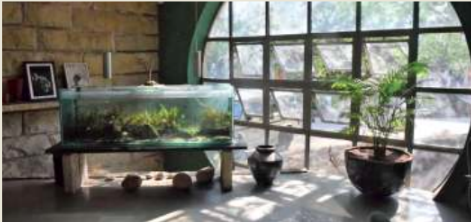
BVIEER Office Established by Dr. Erach Bharucha
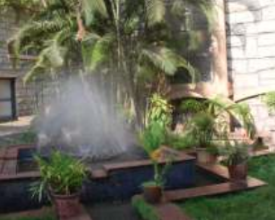
BVIEER Campus
An Educational campus must practice what we teach. We need to uphold the concept of sustainable development by reducing our foot
print as a part of our social commitment. We teach Environment Education (EE) and Education for Sustainable Development (ESD) as an Under Graduate course by placing it within other disciplines. As EE in itself is an interdisciplinary subject this ensures that we are using suggestions with the NEP 2020.
When our Hon. Founder Dr. Patangrao Kadam sahib initiated his second campus in Dhankawadi, it was a degraded abandoned agricultural land which was overgrazed and had poor soil cover. It was essentially tress less but had a single heavily lopped old termite
ridden mango tree. It was a sad tree. It had no branches and no canopy worthy of being called a tree and its bark was severely damaged. It stood alone in the middle of the intended campus while the engineering college was being constructed and the medical college was still in the planning stage.
The first steps towards greening was to develop a garden with formal landscaping of lawns and flowering ground flora. It took a lot of effort in those early years as the soil was poor and water was scarce. But the bare campus began to change when tree cover became a growing need to make the campus ‘look good’. The tree selection focused on exotic flowering trees like Gulmohar Raintrees, Palm trees and Ashoka’s along the internal roads.
Saheb was passionately fond of tree planting and after some events, a ceremonial tree plantation drive in which he would personally plant a tree was fairly common.
At one such event the VIPs were to plant trees at a vacant plot at the rear end of the campus in a degraded treeless plot.
While the eucalyptus trees were being planted someone in the group told him to ask me to also plant a tree. I was trying to hide in the crowd as I was unhappy about the species selection. When I told him it was unadvisable to plant Eucalyptus he jokingly told me that environmental advisors should tell him what should be planted. Interestingly the eucalyptus trees can be seen near to the Environment Institute in front of the new ladies hostel.
Over the next few years the Environment Institute transplanted full grown native trees from the TELCO nursery and has carefully looked after the over several years.
In the year 2000 a full-grown Gaur wandered into the campus and located the plot as being similar to its own habitat. It was the opening of the Science Congress and our invite Sunderlaji Bahuguna commented that this straying wild gaur had been pushed out of his habitat by spreading development and had chosen to settle in the small nature trail. He said we should appreciate that it was a displaced animal. It was tranquilized and transported to the forests of Chandoli, but only after he had changed the Forest Official who had taken a tranquilizer shot at him. The officer had to be admitted and treated at Bharati Hospital urgently as he suffered four broken ribs.
Today the small patch of local trees has grown into a site where our students can do a series of field studies on plant ecology, birds, butterflies and reptiles. In the monsoon there are frogs and toads. We now have a mini protected area for wild creatures.
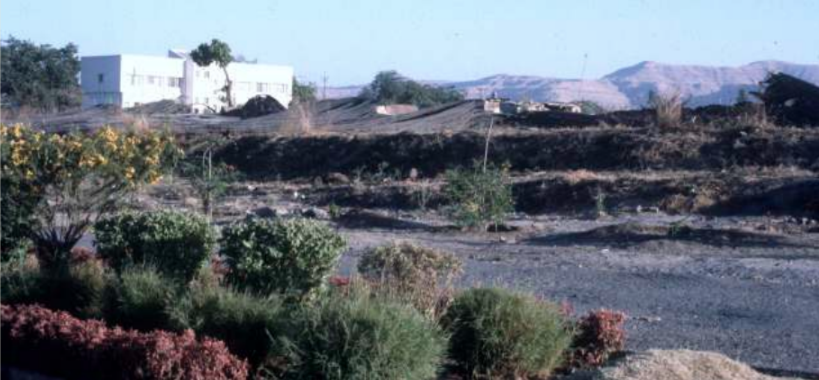
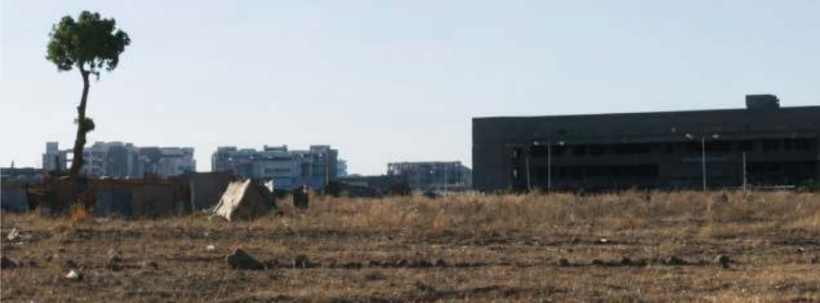
A Solitary ancient mango tree stood as a scarred monument of time watching a cherished dream taking breath
The campus began looking beyond greening to a growing need for water conservation and began addressing Climate Change as a part of our social commitment.
Rainwater harvesting was initiated by Bharati Vidyapeeth Institute of Environment Education and Research (BVIEER) on its rooftops which we discovered was recharging wells in the neighboring new housing colonies.
Efforts were made for using much of our campus rooftops for solar panels driving the campus into a future model of environmental sustainability.
Our waste management is done by triaging paper, plastic, and organic waste.
The UGC Under Graduate course has been implemented for several years by our Bharati Vidyapeeth colleges on EE and ESD. It helps changing mindsets of our students, gives them a carry home message that can become a part of their lives at home and in their hostels.
We are proud of our campus efforts and will continue to pursue the dream of a sustainable campus.
But what future actions can get the campus closer to sustainability. We need to work more closely to the five basic needs of a highly sustainable campus namely – Biodiversity Conservation, Climate Action, by better energy and waste management, water conservation and air quality for supporting our student’s and faculty’s health.
This is a pro planet and people sensitive strategy. Each strategy must begin with awareness generation for nature conservation and a sustainable long-term future of the campus.
1. Biodiversity enhancement: Our type of gardening and campus management must move towards a biodiversity conservation enrichment using species that are able to recreate a habitat for local flora and fauna. It enhances a reconnect with nature’s wondrousecosystem. This requires local trees, shrubs, climbers and ground flora in a minimum of 20% of open space. The outcome is possible if a regular assessment of biodiversity – tree, shrubs, climbers and ground flora is documented regularly and analyzed for further action.A photo documentation with GIS locale mapping helps in monitoring. Seasonal documentation of abundance of each bird species and butterfly species that is seen on the campus is an indicator of enhanced biodiversity health.
2. Air Quality monitoring: This indicates that we are concerned about preventive health and wellbeing of everyone in the campus. Decreasing use of fossil fuel transport and increasing walking and cycling must be encouraged. A assessment of the numbers of scooter, car, users and those who use alternate energy transport, is an indicator of moving towards a healthier campus management. This requires awareness and facilitation by providing bicycles, improving internal transit and parking availability. Study our Air Quality Index periodically to monitor progress.
3. Water Quality Monitoring: The use and misuse of water by each institute can be monitored by students themselves through
a simple training course. Study our grey water waste and use it more efficiently for gardening and use sprinkler systems that save water for our gardening. Study if all buildings have rainwater harvesting at high efficiency levels. A ground water assessment is a good way to achieve better watch for leakages and careless water wastage. Geotag all possible waste sites to monitor them regularly.
4. Waste management: Conduct a Waste Audit for each building separately to examine and modify how solid waste – garbage, paper, plastic and biomedical waste is handled.
Place color coded bins across the campus. Geotag those unauthorized waste disposal areas for regular monitoring and take pictures of good a poor management to get better student participation. A capacity building for front line staff who clean the campus is an urgent need.
The aim is to create a zero plastic campus within 2 to 3 years.
Compost pits need further support and regular maintenance. Use our organic waste for gardening and reduce chemical fertilizer & pesticides down to a minimum. Vermicomposting is easier that one expects.
A ban on single use plastic though complex can become a part of our good management practices across the campus.
5. Energy Assessment: As we move towards renewable energy sources across the world in India, our campus must become a model university.
The assessment is a continuous process and not a onetime activity. Itcomes from a behavior change in students and faculty. Environment education and sessions on Education for Sustainable development can make a better world, a great nation and a model campus at Bharati Campus.
Identify which of the unit’s waste electricity and which make efforts at conserving the use of lights, air conditioning, heating appliances, and computers even when unnecessary. Energy efficient appliances like LED lights, high efficiency BLDC fans, CFCs etc. can further help in reducing energy consumption.
Each unit must calculate its carbon footprint and use more positive actions to save energy as a societal duty.
Summary: BVIEER is one of the good examples of environment management for the rest of the campus as our biodiverse nature trail, proper triage of waste, the use of natural light and ventilation and an ambience that is a home for indigenous flora and fauna makes it a wonderful learning place. Let’s make our BVDU campus a model of sustainable development at Dhankawadi.
